Article
Source-to-Report Lineage Explained
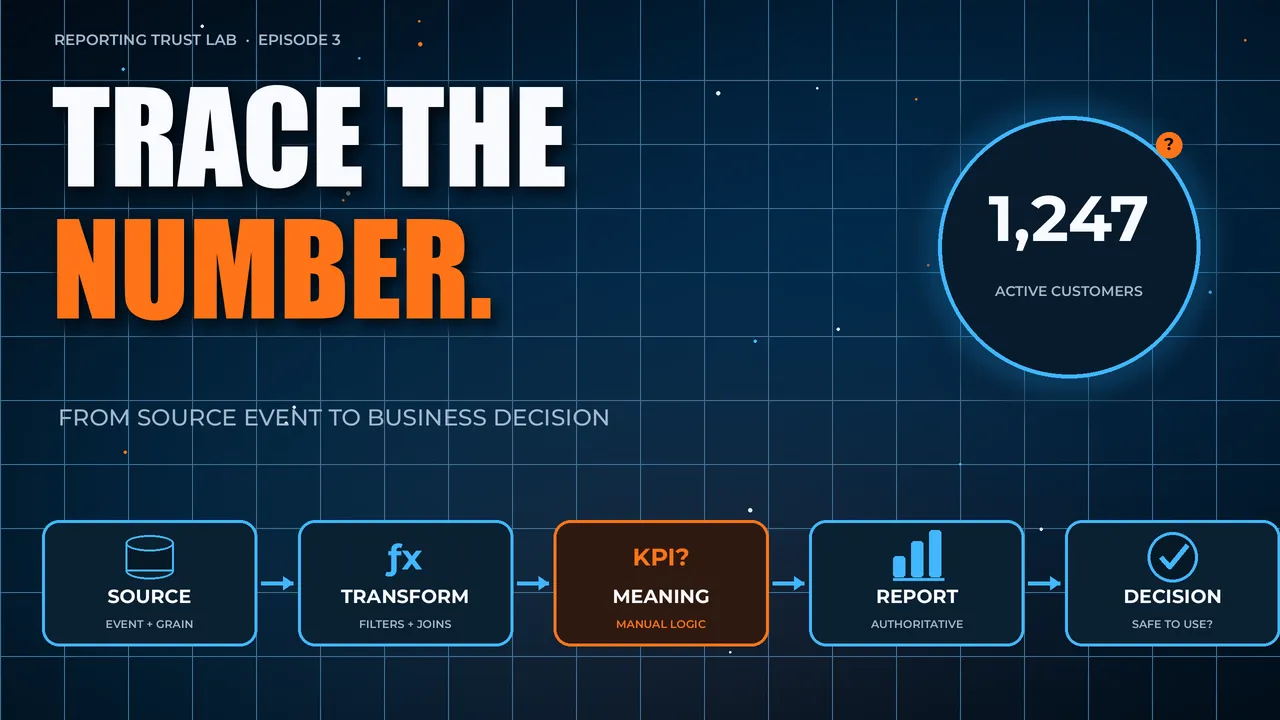
Source-to-report lineage is the path a business number takes from the system where it starts to the report where someone uses it.
That sounds technical, but the business problem is simple.
If leaders cannot see where a number came from, where it changed, and which assumptions were applied along the way, they cannot fully trust it.
Lineage matters most when the same number appears in more than one place. A finance pack, dashboard, spreadsheet, and source system may all show a version of revenue, margin, conversion, churn, or pipeline. If those numbers disagree, the business needs more than a debate about which report looks right.
It needs the path.
Inside the Data Value Chain, source-to-report lineage mostly sits in Transform. When the semantic layer is shown, the chain is:
Capture -> Transform [Semantic Layer Gate] -> Interpret -> Act -> RealiseLineage helps the Semantic Layer Gate explain how captured reality became a trusted representation. That matters, but it is not the whole chain. The business still has to interpret the number, act on it, and realise value from the response.
What source-to-report lineage means
Source-to-report lineage connects four things:
- The original source system
- The transformations applied to the data
- The business definition of the metric
- The final report, dashboard, pack, or spreadsheet where the number is used
The source might be a CRM, billing platform, ecommerce system, product database, finance system, or spreadsheet.
The report might be a board pack, BI dashboard, operating review, investor update, department scorecard, or manually prepared spreadsheet.
Lineage is the route between them.
It answers questions like:
- Where does this number begin?
- Which fields are used?
- Where is the data filtered, joined, grouped, or adjusted?
- Which definition is being applied?
- Which report is the authoritative output?
- Where are caveats or manual steps introduced?
This is not about documenting every technical detail for its own sake. It is about making the important reporting path clear enough for people to trust the number.
Why lineage matters when numbers do not match
When numbers disagree, teams often jump straight to the visible outputs.
Someone opens the dashboard. Someone opens the spreadsheet. Someone checks the finance pack. Someone exports from the source system.
That can be useful, but it rarely solves the underlying problem.
Two reports can disagree because they are using different definitions. They can disagree because they are pulling from different systems. They can disagree because one includes manual adjustments and the other does not. They can disagree because one is refreshed daily and the other is finalised monthly.
Without lineage, those differences stay hidden.
The conversation becomes personal:
“Whose number is right?”
With lineage, the conversation becomes operational:
“Which path produced this number, and is that path appropriate for this decision?”
That shift matters.
If the immediate problem is a dashboard, spreadsheet, or finance pack mismatch, start with a dashboard reconciliation checklist before documenting the full reporting estate.
A simple example
Imagine a leadership team reviewing monthly revenue.
The dashboard shows one number. Finance shows another. A sales spreadsheet shows a third.
The dashboard pulls orders from the ecommerce system by order date. Finance uses invoiced revenue after credits and month-end adjustments. The sales spreadsheet includes expected late payments that have not been invoiced yet.
Each output may be useful.
But they are not answering the same question.
Source-to-report lineage helps the team see that the disagreement is not only a data quality issue. It is a context issue. The same word, “revenue”, is being used across different paths, timing rules, and decision needs.
Once that is visible, the business can decide which number belongs in which conversation.
Symptoms of missing lineage
Missing lineage usually shows up before anyone calls it a lineage problem.
You may see:
- Leaders asking which dashboard is correct
- Finance maintaining manual reconciliations outside the BI tool
- Analysts repeatedly explaining why numbers moved
- Teams exporting data because they do not trust the report
- Metrics that nobody can confidently define
- Reports that depend on one person remembering the caveats
- AI or automation projects blocked by unclear source logic
These symptoms are expensive because they slow decision-making.
They also create a hidden dependency on individual memory. If only one person knows where the number comes from, the business does not really have a trusted reporting process. It has a person holding the process together.
What leaders should ask first
Leaders do not need to inspect every join, model, or transformation personally.
But they should be able to ask better questions.
Start with the metric that causes the most friction and ask:
- What decision does this metric support?
- Which source system does it begin in?
- Which report is supposed to be authoritative?
- Who owns the business definition?
- Are there manual adjustments?
- Are there timing rules or cut-offs?
- Are there caveats that should be visible to decision-makers?
- Where else does a similar number appear?
These questions are intentionally high-level. They do not replace a full source-to-report map or implementation workflow.
They help the business decide whether a number is trusted enough for the decision in front of it.
Lineage is not just a technical artefact
A common mistake is to treat lineage as something only the data team needs.
Technical lineage is useful. It can show tables, models, fields, jobs, and dependencies. But reporting trust also needs business lineage.
Business lineage explains what the number means, why it is used, who owns it, which caveats matter, and where it is safe to apply.
Both views matter.
A technically accurate pipeline can still produce an untrusted report if the business definition is unclear.
Likewise, a well-written business definition is not enough if nobody knows where the data starts or how it changes before it reaches the dashboard.
The useful version connects both sides.
Where source-to-report lineage fits in reporting trust
Source-to-report lineage is one part of reporting trust.
It does not solve every problem by itself. You still need clear KPI definitions, ownership, caveats, quality checks, and agreement about which numbers are authoritative. Those pieces form the trust signals that help users understand whether a report is safe for a decision.
It is also one part of the wider Data Value Chain. Lineage can show whether the Transform stage is trustworthy, but a trusted report can still fail if people cannot interpret it, no one owns the action, or the business cannot connect the action to realised value.
But lineage is often the point where vague reporting debates become specific.
Instead of arguing about the final number, teams can inspect the path.
That path shows where definitions diverge, where timing differs, where manual logic appears, and where reports have copied old assumptions.
This is why lineage is especially valuable before investing in more dashboards, automation, semantic-layer tooling, or AI reporting. If the path is unclear, new tools may simply make the same confusion faster.
What to do next
Pick one disputed metric.
Do not start with the entire reporting estate. Start with the number that creates the most leadership friction.
Write down the source system, the basic business definition, the main transformations, the final reports where the number appears, and the caveats people need to know.
That first sketch will usually reveal whether the problem is a broken report, an unclear definition, a timing difference, or a hidden manual step.
If you are dealing with mismatched dashboards and finance packs, start with why your business numbers don’t match or the dashboard reconciliation checklist. If one KPI is actively disputed, read how to diagnose a disputed metric. If the problem is already consuming time across meetings and reconciliation work, read the Invisible Data Tax.
For the deeper Reporting Trust framework, use the book. For the AI and semantic-layer angle, read AI across the Data Value Chain. For structured KPI definition, source-to-report, value-chain diagnosis, and improvement planning worksheets, use the Reporting Blueprint Toolkit.