Hands-on analytics engineering
Production dbt delivery, legacy-model refactoring, Snowflake and BigQuery modelling, automated testing, CI/CD, data-quality controls and maintainable analytics architecture.
UK-based · Remote with UK and international teams
Hands-on delivery across dbt, Snowflake, BigQuery, Looker and business-critical metrics.
I join data and finance teams to deliver, refactor and stabilise production analytics systems. The work combines more than eight years of analytics engineering experience with practical control over model grain, semantic logic, testing, reconciliation and the reporting decisions downstream.
Contract, interim and fixed-scope support
Production dbt delivery, legacy-model refactoring, Snowflake and BigQuery modelling, automated testing, CI/CD, data-quality controls and maintainable analytics architecture.
Looker and LookML development, reusable metric logic, dimensional modelling, KPI definitions, source-to-report lineage and dashboard reconciliation.
Fixed-scope investigation of one contested business metric across finance, CRM, spreadsheets, transformations, dashboards and decision workflows.
Senior analytics engineering and reporting support for data-platform, ERP, CRM, finance-transformation and AI-readiness programmes.
Selected delivery evidence
Reporting Trust is grounded in hands-on analytics engineering delivery. These examples show the kinds of systems, transformations and reporting foundations I have built and improved in production roles.
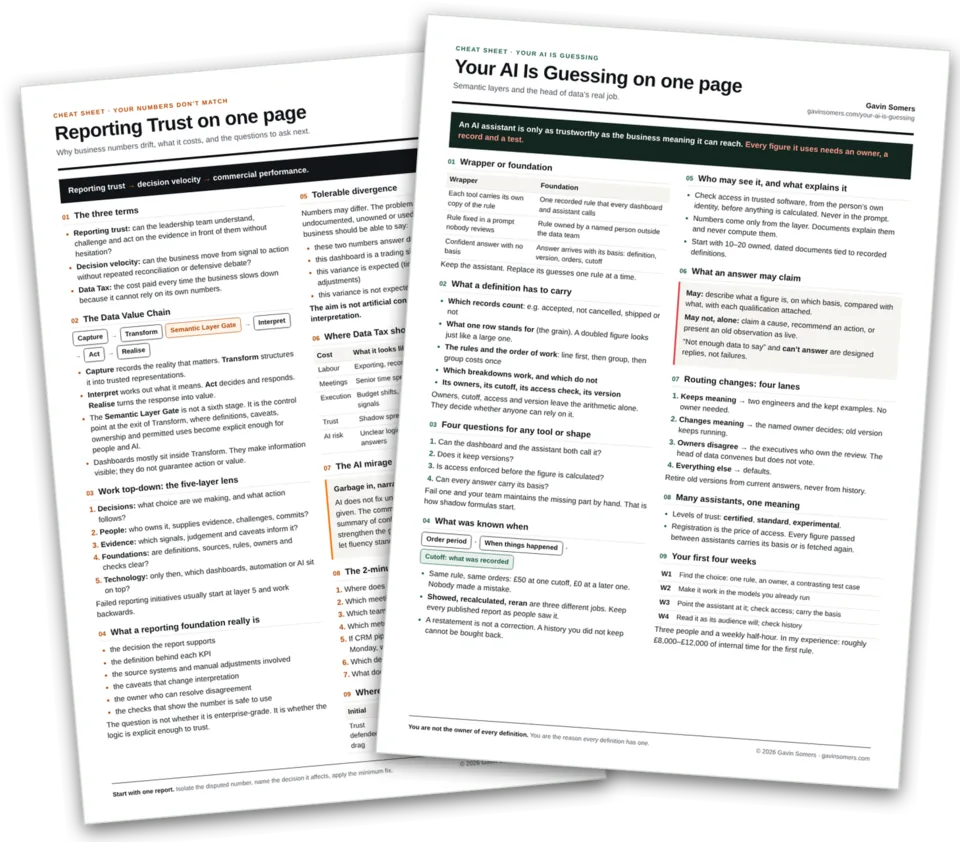
The Data Value Chain
Reporting Trust is what stops the chain breaking between technical delivery and business value. With the semantic layer made explicit, the chain is Capture -> Transform [Semantic Layer Gate] -> Interpret -> Act -> Realise. The gate is the control point at the exit of Transform, not a sixth stage.
The systems, events, fields, and behaviours that record what is happening.
The models, definitions, joins, semantic rules, reports, dashboards, and recurring packs that make data usable.
The context, caveats, evidence, and judgement needed to explain what the numbers mean.
The decision, owner, workflow, or operating rhythm where understanding changes behaviour.
The commercial, operational, or risk outcome the business can connect back to the action.
The Reporting Trust Framework
AI can accelerate the Data Value Chain, but the semantic layer decides whether it accelerates clarity or confusion. Reporting Trust is the condition that lets humans and AI use business numbers safely.
The problem
Dashboards, finance packs, spreadsheets, and source systems show different answers for the same business question.
The business meaning layer is undocumented, so teams cannot tell which definitions, caveats, or assumptions are safe to reuse.
Leadership time shifts from deciding what to do into debating which number is safe enough to use.
Automation and AI make the problem faster if definitions, ownership, caveats, and source logic are not trusted first.
Fixed-scope diagnostic
The Metric Trust Audit traces one contested metric across the Data Value Chain, including its semantic assumptions and AI-readiness risk, then shows where trust breaks and what to fix first.
Supporting resources
The opening chapter introduces the reporting trust problem and the first places to inspect.
Get Free ChapterThe complete field guide for leaders and data teams who need a shared way to restore trust.
Buy the BookA separate self-serve digital package for documenting the Semantic Layer Gate, AI-readiness risks, and the practical improvement plan.
Buy the ToolkitSixty controlled AI workflows for dbt, SQL, semantic layers, testing, documentation, pull requests and analytics engineering governance.
View the KitFree chapter
Request the free opening chapter by email and get the PDF delivered directly to your inbox. Paid book and toolkit purchases use the separate checkout flow.