New book · For heads of data

Your AI Is Guessing

Semantic layers and the head of data’s real job

Your leadership team wants an AI assistant on the numbers. It will answer instantly, fluently and with complete confidence. The question is whether it is quoting a rule your business decided, or one it invented on the spot. This book shows how to make sure every figure an assistant uses has an owner, a record and a test, and why that discipline is the head of data’s job.

Your AI Is Guessing book cover by Gavin Somers: a desk lamp lighting a single card on a dark desk

The argument

An assistant is only as trustworthy as the meaning it can reach

Better models will write better SQL. They still can’t decide which refunds count, which orders are in or what was known when. Those are business decisions, and where nobody has written one down, the assistant makes one up and sounds just as sure.

A semantic layer is where a data team turns those rules into something every dashboard and every assistant must use. Building it is less a software project than a discipline. Owners decide what a rule means; the head of data makes sure each one is decided, recorded, tested and kept current.

  • Who it is for: Heads of data, VPs of data and CDOs, and the analytics engineers who build with them.
  • The decision it helps you make: build AI as an ad-hoc wrapper on messy data, or on decided, recorded and owned meaning.
  • How it works: one fictional retailer, one lamp and one £50 figure, followed through ten chapters. Every figure adds up.
  • Formats: PDF, and an HTML edition that works offline with interactive diagrams you can step through.
  • What it is not: a tool tutorial, a vendor comparison or a prompt-engineering guide.

Inside the book

The journey of one question

“What did we make on paid search?” A wrapper writing its own formula gives a confident, wrong answer. An assistant that asks the semantic layer gets £50 contribution, not profit: access-checked, defined by its owner, fixed to a cutoff and returned with its basis.
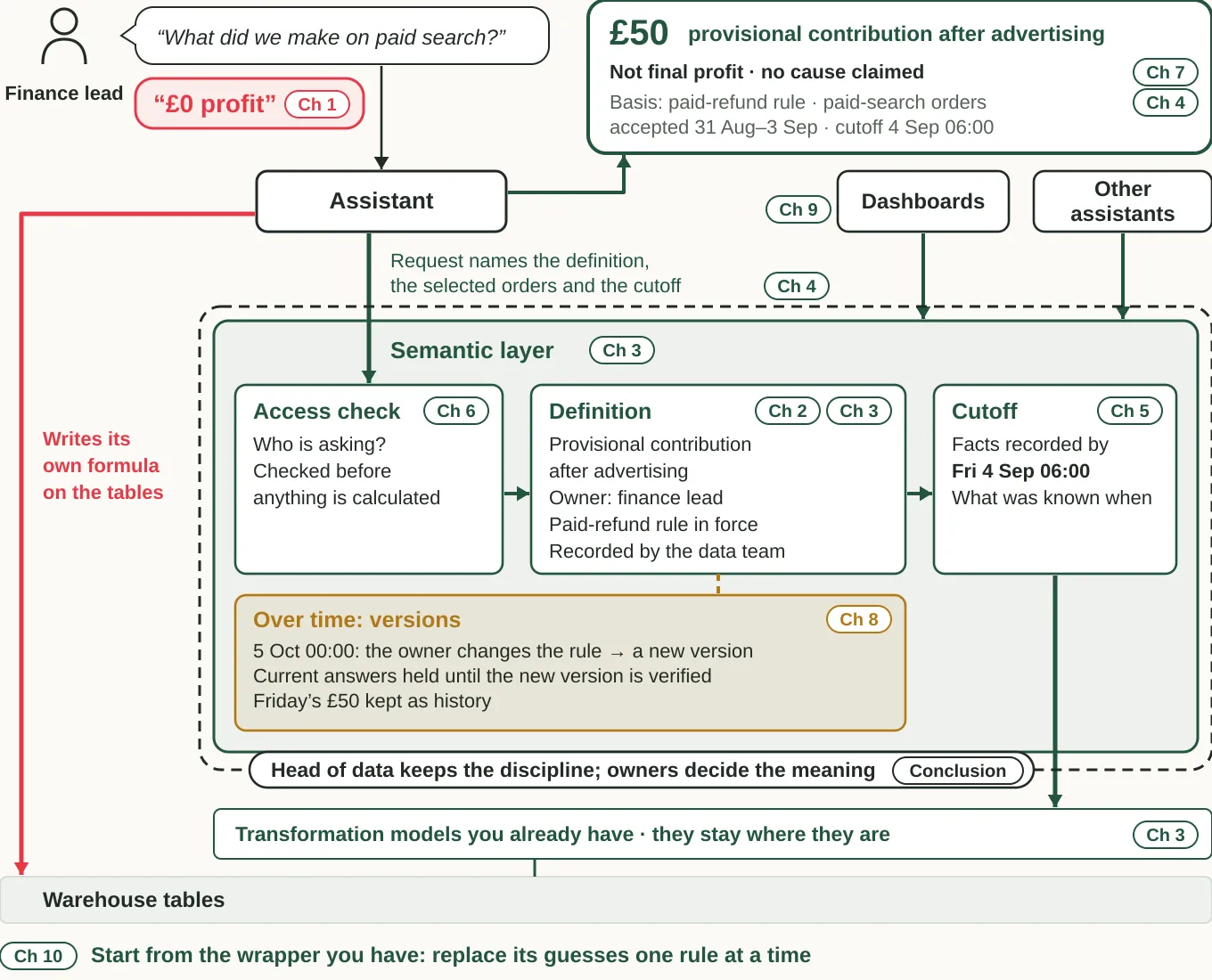
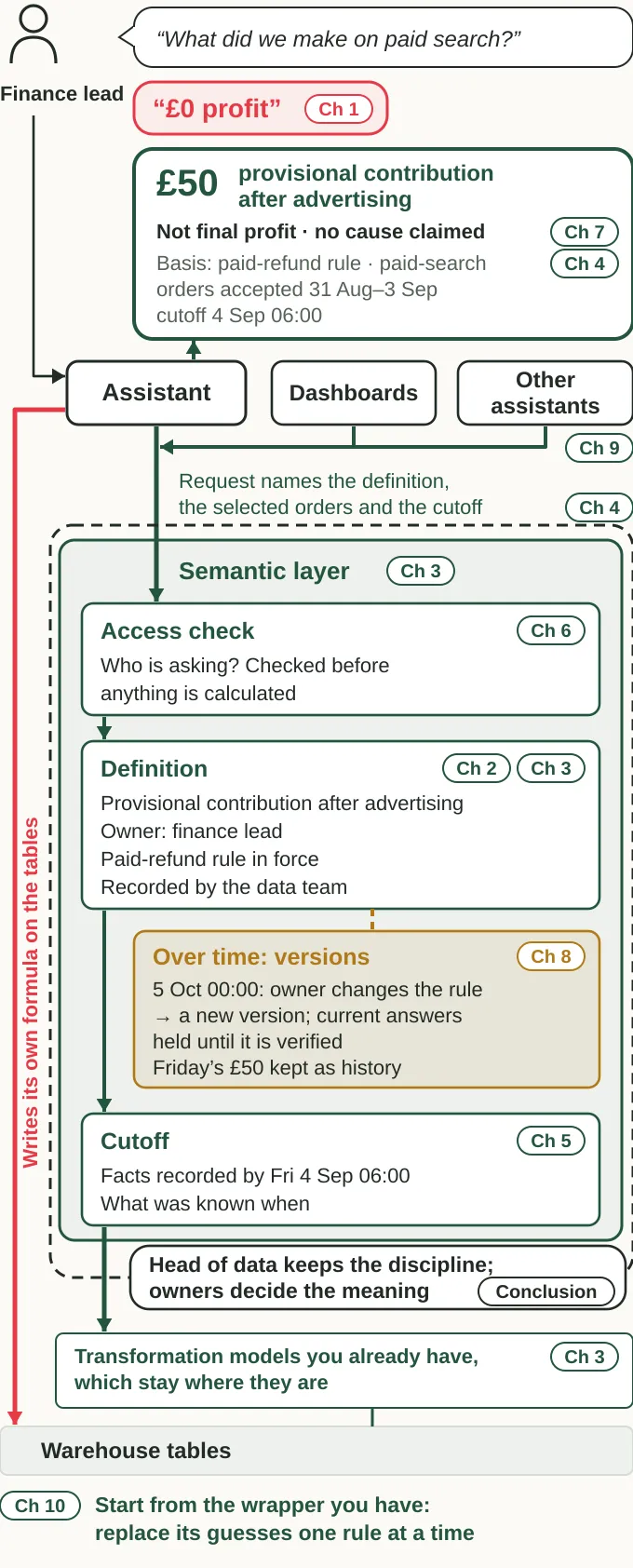
Diagram: a finance lead's question travels either straight to the warehouse tables via a wrapper's own formula, giving a wrong answer, or through the semantic layer's access check, owned definition and cutoff, returning £50 contribution with its basis. Diagram: a finance lead's question travels either straight to the warehouse tables via a wrapper's own formula, giving a wrong answer, or through the semantic layer's access check, owned definition and cutoff, returning £50 contribution with its basis.
The book’s overview diagram, with the chapter that covers each stage. Step through the interactive version →
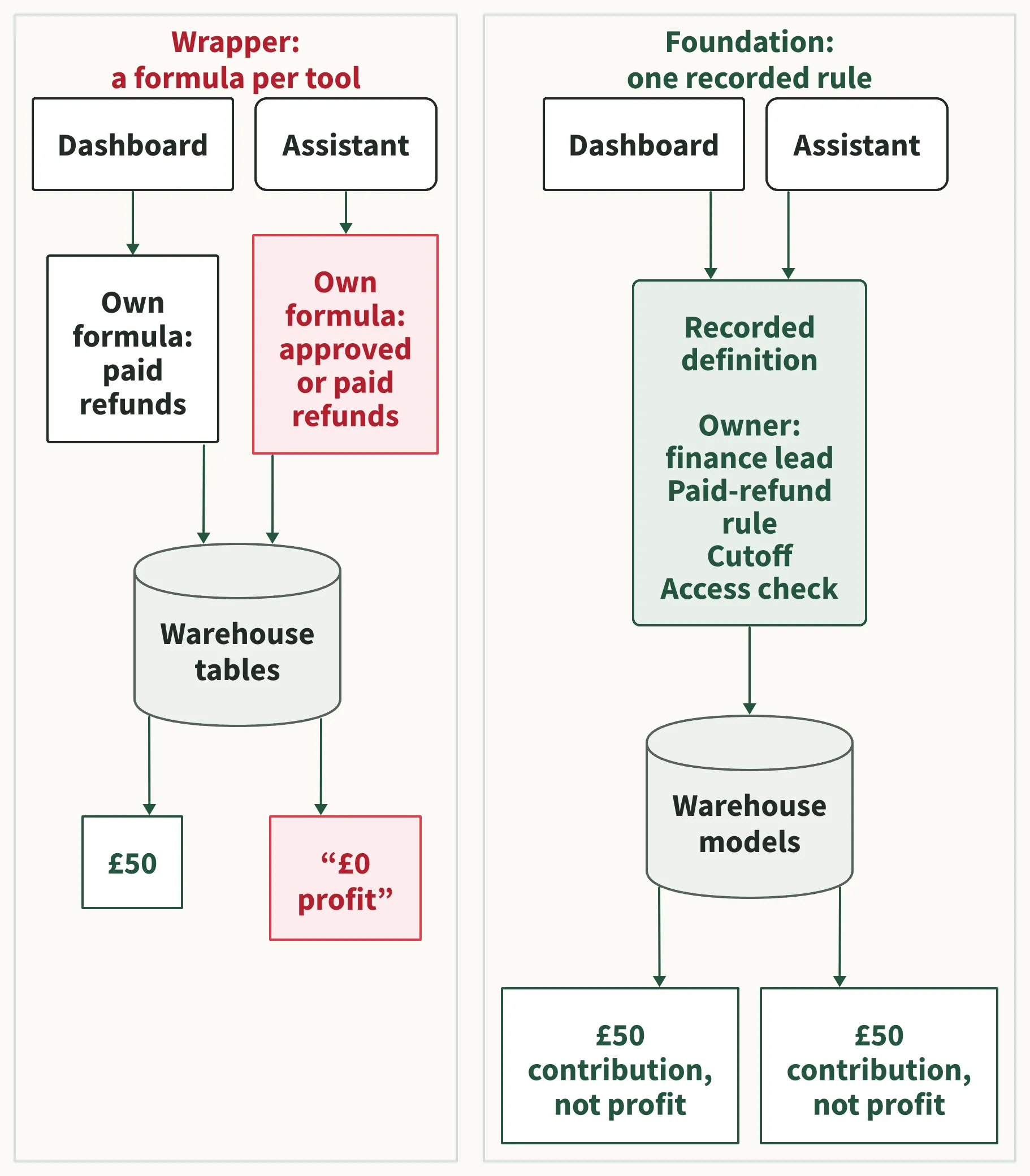
Diagram: in a wrapper, the dashboard and assistant each carry their own formula and disagree; in a foundation, both call one recorded definition owned by the finance lead and both return £50 contribution, not profit.
Chapter 1. A wrapper carries its own copy of the rule. A foundation makes the dashboard and the assistant call one recorded rule.
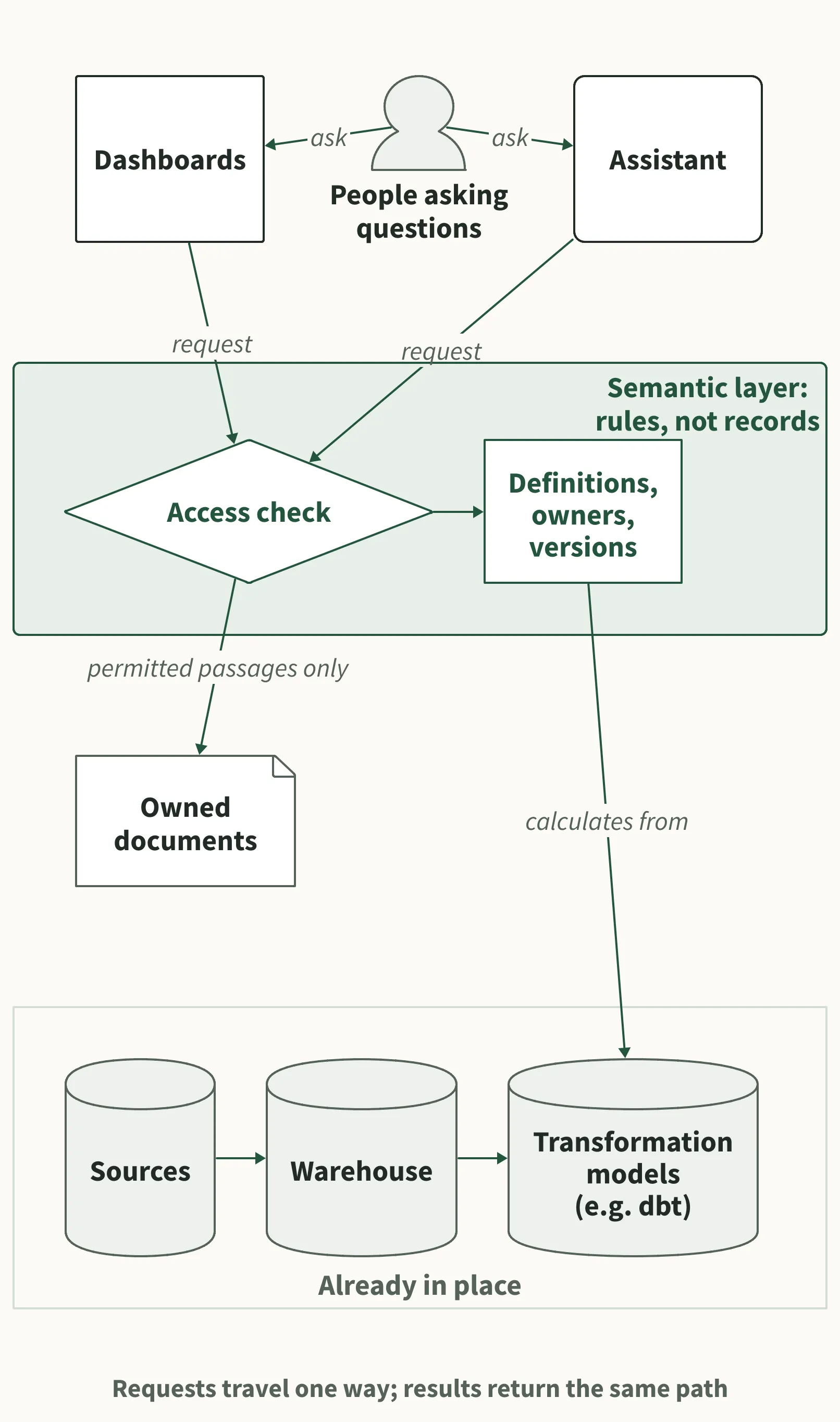
Diagram: people ask dashboards and the assistant; both send requests through an access check to definitions, owners and versions, which calculate from the transformation models, warehouse and sources already in place.
Chapter 3. The semantic layer sits between the models you already build and every tool that shows a number. It replaces none of them.

Contents

Ten chapters, one figure

  1. The assistant that was sure Flawless arithmetic, the wrong rule: why a confident £0 came from a refund rule nobody had written down.
  2. Find the rules nobody wrote down Follow one figure home, and give every rule an owner outside the data team and a test case.
  3. What a semantic layer is, and where it sits What a definition has to carry, three shapes to hold it, and four questions to judge any tool.
  4. What the assistant may ask for, and what it hands back Follow-up questions, can’t answer as a designed reply, and the basis that travels with every number.
  5. What was known when Three clocks, two zeros, and why “showed”, “recalculated” and “reran” are different jobs.
  6. Who may see it, and what explains it Access checked before anything is calculated; documents explain numbers and never compute them.
  7. What the answer may claim Describe, yes. Cause, recommendation or stale data presented as live: not without evidence.
  8. When the meaning changes Four lanes for routing changes, two versions under one label, and retired-not-removed.
  9. Many assistants, one meaning Levels of trust, a register of assistants, and keeping the basis when figures pass between them.
  10. From the wrapper you have to the foundation you need Keep the assistant, replace its guesses: the first four weeks, the team and the cost.

Plus an introduction, a conclusion (“the job that is yours”) and an appendix, For the people who build it, for your analytics and platform engineers.

Get the book

Digital book, delivered after checkout

£19PDF and HTML ebook

A one-time digital purchase. After checkout, Lemon Squeezy sends the download link and receipt by email.

Both books · save £6

Both books for £22

Your AI Is Guessing for the head of data, and Your Numbers Don't Match for the leadership team you need on side. Bought separately they are £28.

£28 £22 Save £6 · Both books in PDF and HTML

Free cheat sheet pack

Both books, one page each

Both books on one page each: Your AI Is Guessing for the data leader, and Reporting Trust for the leadership team.
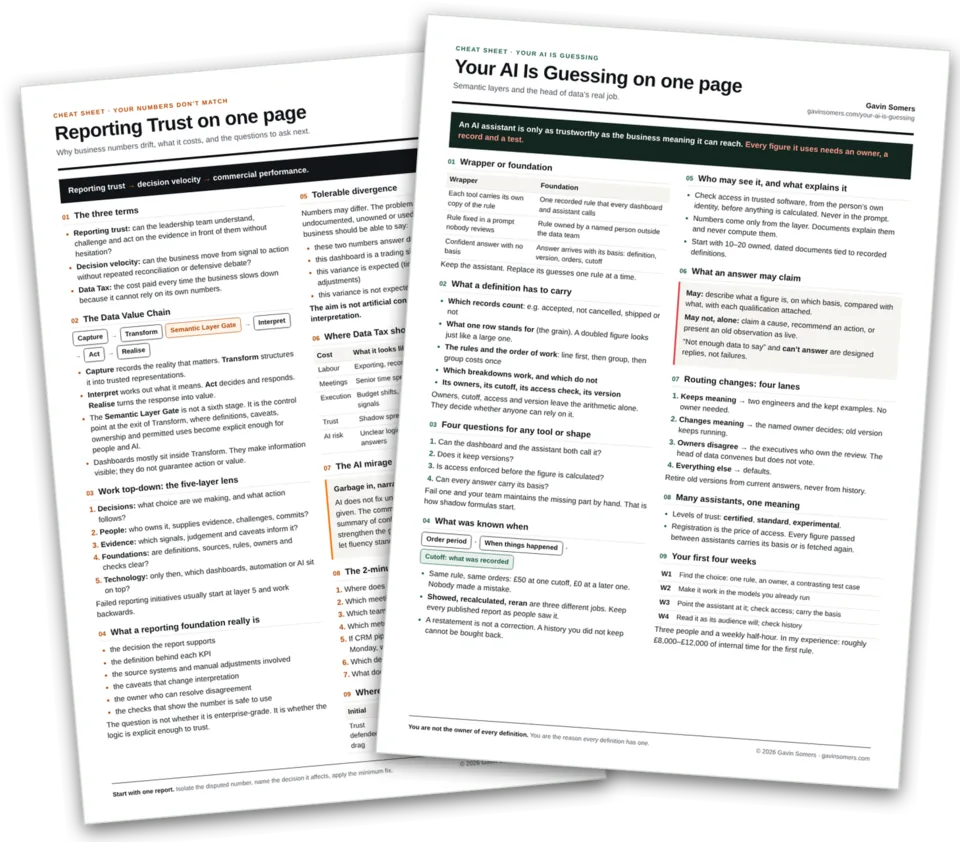
  • What every figure needs before AI can use it: an owner, a record and a test
  • Wrapper or foundation: the choice on a head of data's desk
  • Why dashboards, finance packs and spreadsheets disagree, and the Data Tax it costs
  • A 2-minute check to take into your next leadership meeting
Preview of the two one-page cheat sheets: Your AI Is Guessing on one page, and Reporting Trust on one page

Companion products

Pairs well with

Book · for the leadership team

Your Numbers Don't Match

The leadership-level case for Reporting Trust: why numbers drift and what the disagreement costs. Useful for getting your sponsors on side.

About the Book